
Tomato Newsletter No. 231 - November 2020
Your monthly resource on working capital, process optimization, and issues related to the world of corporate treasurers, IT professionals, and bankers!
This newsletter is bilingual, English or German, depending on the source.
Introduction
There is no doubt that 2020 was a tough and unpredictable year. Despite the economic uncertainty and changes in social interactions, we managed to keep business and personal relationships as accessible as possible with the help of technology. The years of trial and error were compressed into a few months. We quickly learned that distance is not an obstacle to achieving great things, and that trust is the true bond that holds us together.
At Tomato, we are grateful to have been the partner you’ve been looking for in your business endeavors. As the year draws to a close soon and you’re preparing the roadmap for 2021, remember that we are happy to join you in your new business strategies or even help you in developing one, from a financial perspective.
This month’s Catch-Up includes topics such as Supply Chain Finance in the TMS, Open Banking in der Schweiz, Hybrid vs Multi Cloud, Libor Mitigating, Cashflow Hedges, etc.
Remember that for any challenge related to your financial issues, you can ask Martin Schneider for a discussion that will clarify it. Contact Martin via email or call +41 44 814 2001.
- Supply Chain Finance as a Module Inside a TMS?
- Open Banking in der Schweiz
- Board of Directors Are Accelerating Digital Business Initiatives Due to Corona
- LIBOR Mitigating Risks
- Navigating the Rising Tide of Uncertainty
- Taxes in Switzerland: Explaining The Patent Box
- Multi-Cloud vs Hybrid Cloud – der feine Unterschied
- Abbildung von Cash Flow Hedges in der OR-Rechnungslegung
- Book Tip: Good to Great: Why Some Companies Make the Leap and Others Don't
- Termine & Events
- From the Desk of Tomato
1. Supply Chain Finance as a Module Inside a TMS?
By Martin Schneider.
20 to 30 years ago, a TMS was able to transact FX, interest rate transactions, single manual treasury payments, its reporting with MT940 for a financial status and liquidity planning, netting, guarantees. Usually, today there are also mass payments with all the user rights, audit trails, and many other things.
Will Vendor Finance themes a module of a TMS? Or also fraud detection?
Is it important to include supply chain features in a TMS as a module? I guess yes.
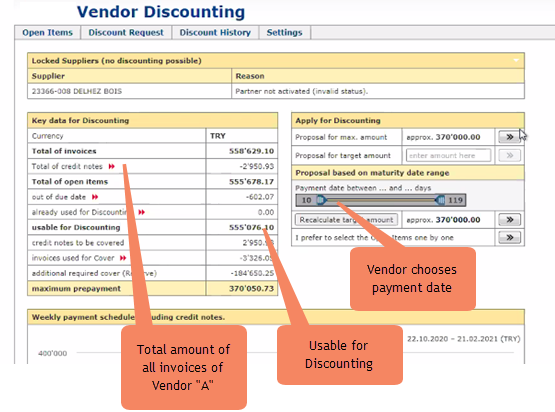
Recently, I joined a session of a local Swiss Vendor Financing Tool, which is implemented and runs at a bigger corporation as internal browser software. Each local entity of that corporate has the feature to deal with its local supplier and local banks into that Vendor-Finance-System. Once pre-negotiated with suppliers and banks, basic data are set up by the Group Treasury, then local suppliers and local banks can use their data within their contract area and in a way that allows the supplier to choose his own payment date.
Would it make sense to include such a system in a TMS? Can this be the future?
Are you interested to find out more about this excellent software tool? Ask for information at martin.schneider@tomato.ch or +41 44 814 2001, see screen below.
Listen to the podcast at TreasuryManagement.com where Coupa and Bellin discuss the TMS-future - Donna Wilczek, Coupa Software, François Masquelier, Simply Treasury, and Martin Bellin, BELLIN.
The podcast is 33 minutes long; due to the length to listen, it is unfortunate that the podcast has no minute-agenda-indication to flip to a preferred theme.
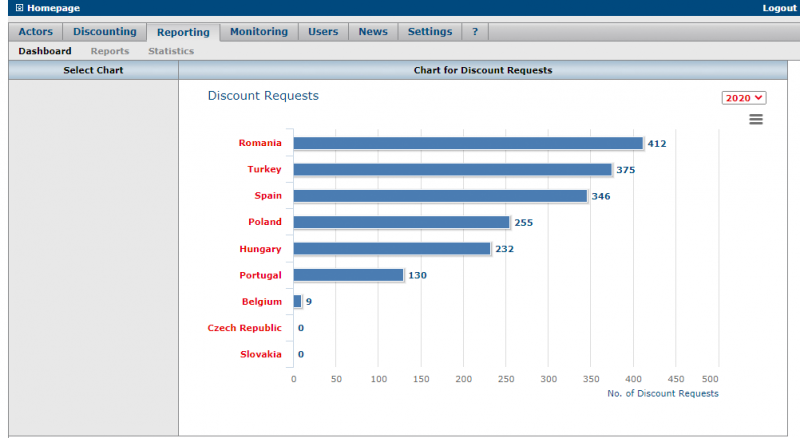
2. Open Banking in der Schweiz
In den EU-Mitgliedsstaaten bilden die PSD2 Richtlinien seit September 2019 die Grundlage für Nicht-Banken mit Schnittstellen am Zahlungsverkehr teilzunehmen. Als nicht-PSD2 Mitglied besteht für die schweizerischen Finanzinstitute keine Verpflichtung zur Bereitstellung von Schnittstellen. Finanzinstitute und Drittanbieter können die Bedingungen für das offene Bankgeschäft selbst gestalten und sich aktiv an der Entwicklung neuer Geschäftsmodelle einbringen.
In der Schweiz laufen verschiedene Initiativen, um die Option Open-Banking zu schaffen. Siehe Tomato‘s Fachbericht
Die Schweizerische Bankiervereinigung erachtet den gegenwärtigen marktorientierte Ansatz als vorteilhaft. Es gibt noch zahlreiche Herausforderungen, wie Professor Dr. Andreas Dietrich von der Hochschule Luzern in einem Blog beschreibt.
Gegenwärtige Lösungen von Software-Anbietern:
- Avaloq.one mit über 100 Fintechs an Bord
- Offene Plattform Finnova
- Open-Banking-Plattform Lenzburg/Finstar
- Swisscom Open Banking Hub
- b.Link der SIX unterstützt von Klara, Credit Suisse, Neue Aargauer Bank, UBS und ZKB
Hier zum Blog von Prof. Dr. Andreas Dietrich, Hochschule Luzern
3. Board of Directors Are Accelerating Digital Business Initiatives Due to Corona
According to the 2021 Gartner Board of Directors Survey, 69% of boards of directors accelerated their digital business initiatives following COVID-19 disruption. Moreover, almost 50% anticipate changing their organizations' business models.
Other key findings:
- 67% expect budgetary increases in technology, while marketing and HR are expected to experience budgetary cuts;
- 7% increase is expected in the IT budgets for 2021;
- Analytics and artificial intelligence are expected to emerge stronger as game-changer technologies;
- 86% deem technology as having a transformational role in addressing strategic business priorities (most organizations consider the creation of a new Chief Digital Officer role);
- Almost all respondents expect functional leaders to collaborate with one another, more than 50% believe that CIOs serve as partners with senior business leaders, while over a third look to the CIO to lead digital business issues alone.
The survey was carried out online, from May through June 2020 with 265 respondents in the US, EMEA, and APAC in a board of directors’ role or a member of the corporate board of directors.
Read the Gartner article in English
Bevorzugen Sie Deutsch? Lesen Sie die Übersetzung bei IT-Markt.ch
This CFO.com article shows transition risks when mitigating from Libor to new national rates as ESTR EUR, SARON CHF, SOFR USD and SONIA GBP etc.
In a perfect world, one would hope that the respective parties to the loan documents could simply agree that an alternate rate is needed and devise an appropriate substitute. Unfortunately, the world is not perfect. Given the likely landscape, litigation will take place, and financial institutions would be well advised to consider the following steps to mitigate risk.
- Examine all outstanding LIBOR-based loans to see which have inadequate details of when an alternate rate must be implemented and how the parties will determine the said rate.
- For the identified loans, begin an open conversation with the other parties to the loan transaction about when the rate will be substituted and what will be the substitute. Lenders should be prepared to demonstrate how the proposed alternate rate compares to LIBOR and its anticipated effects on the borrower’s payment obligations. Once the parties agree to the alternate rate, an amendment to the loan documents should be prepared.
- If the parties cannot reach an agreement, the lender should document all the efforts to reach an agreement. This will evidence fair dealing on behalf of the lender and may mitigate its risk of liability or an adverse judgment by the court. The sooner the lender can evidence its attempts to communicate with the borrower, the better.
Read here the CFO.com article in English
5. Navigating the Rising Tide of Uncertainty
Bob Moritz, Chairman of the PwC Network, shares a preview of PwC’s 23rd Annual Global CEO Survey with a focus on rising chief executive pessimism and uncertainty heading into 2020.
Key highlights:
- More than half (53%) of CEOs believe the rate of global economic growth will decline;
- The share of CEOs very confident in their 12-month growth prospects fell to 27%, the lowest level since 2009;
- Uncertainty around regulation, trade, and economic growth contribute to the decline in CEO confidence;
- CEOs are divided over whether government legislation will splinter the internet;
- 18% of organizations globally cite significant progress in establishing an upskilling program.
Here to the PwC's eye-catching CEO survey overview:
The full PwC report can be accessed here
6. Taxes in Switzerland: Explaining the Patent Box
Upon a taxable person's or company's request, the net profit resulting from patents or income from patents is taken into account in the ratio of qualifying R&D expenses to total R&D expenses per patent for the calculation of the taxable net profit. This results in a reduction in income of up to 90%, entailing tax advantages. In order for patents to be taken into consideration for the box, they must relate to R&D activities.
Moreover, up to 150% of the commercially justified Research & Development (R&D) expenses incurred, directly or indirectly via third parties, by a taxable person or company in Switzerland may be deemed deductible. In Switzerland, the competence lies with the cantons, which may grant their approval upon request. This regulation favors both large companies and SMEs operating in research, development, and innovation.
Article based from the two companies IPrime Rentsch and Balmer Etienne
Do you prefer English at Patent-Box.ch?
Ziehen Sie Deutsch vor bei Patent-Box-ch?
7. Multi-Cloud vs Hybrid Cloud – der feine Unterschied
Eine Hybrid Cloud besteht immer mindestens aus einer Public und einer Private Cloud. Sie ist eine einzelne Einheit aus Private-Cloud- und Public-Cloud-Umgebungen. Dies kann eine beliebige Kombination aus SaaS, IaaS, PaaS oder jeder anderen "As-a-Service-Umgebung" sein.
Eine Multi-Cloud hingegen ist von Natur aus kein "einzelnes Ding", sondern eine Reihe von unabhängigen Dingen, die unter eine zentrale Verwaltung gestellt werden. Daten und Prozesse neigen dazu, sich in einer hybriden Umgebung zu vermischen und zu kreuzen, während in einer Multi-Cloud-Situation die Nutzung typischerweise im Silo der "eigenen" Cloud bleibt.
Die Multi-Cloud bietet Flexibilität und Wahlmöglichkeiten, führt aber auch zu Komplexität. Die Multi-Cloud ermöglicht es, für jede Anwendung zwischen verschiedenen Cloud-Optionen zu wählen. Daher wird in einer Multi-Cloud-Welt mehr Zeit mit der Verwaltung von Service-Levels, der Überwachung der Konnektivität an verschiedenen Standorten und der Navigation durch die verschiedenen verfügbaren Tools verbracht. Darüber hinaus spielt das Thema Governance und darin insbesondere die Data Governance eine wichtigere Rolle.
Der Bericht aus Netzwoche in Deutsch
8. Abbildung von Cash Flow Hedges in der OR-Rechnungslegung
In vorherigen Tomato Catchup News haben wir Ihnen mehrere Berichte von Dr. Silvan Loser übermittelt. Verschiedene Leser haben diese Berichte besonders geschätzt. In einem neuen Artikel befasst sich Dr. Loser mit Hedge Accounting.
Auf 32 Seiten geht der Autor Silvan Loser auf diese Themen in den 32 Seiten Report:
- Hedge Accounting und Cash Flow Hedges
- Grundsätzliches zur Bilanzierung von Derivaten
- Abbildung von Cash Flow Hedges
- Fallbeispiele bei der Cash AG
Der KPMG Bericht in PDF in Deutsch
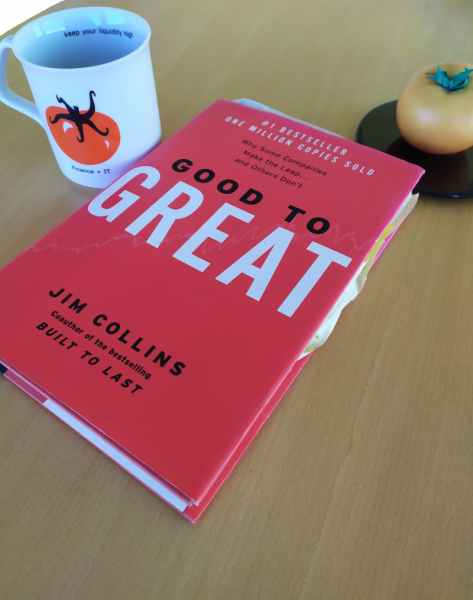
9. Book Tip: Good to Great: Why Some Companies Make the Leap and Others Don't
We suggested this book to our reader’s years ago. We like it so much that it has become Tomato's bible. Therefore, we want to share it with you once more.
The book centers on two main ideas: How companies become great and how examples of good practice can be replicated by anyone. The main highlights:
- To go from a good to a great company you need disciplined people, disciplined thought, and disciplined action;
- Good is the enemy of great;
- A company with the wrong people can never become great;
- Great companies are prepared to grow only at the rate they can hire the right people;
- Great companies let go of the wrong people and don’t overlook the possibility that the right people might just be in the wrong positions;
- Managing problems well can make organizations good, but only exploiting opportunities can make them great;
- Good to great companies stick to doing what they’re best at and avoid getting distracted by being everything to everyone;
- Most companies fail not because of the lack of opportunity but because there is too much opportunity, and they spread themselves too thinly.
- Structured Finance Virtual: Montag bis Donnerstag, 23-26. November 2020
Enjoy your coffee break with Tomato Cups – How will this work when it is digital?
5% out of 2.000 participants chosen by lottery will receive the famous Cult Tomato Cup by mail. If you are missed, contact us.
We are proud of 9 years of cooperation with Structured Finance. See here the Tomato-Sponsor Text.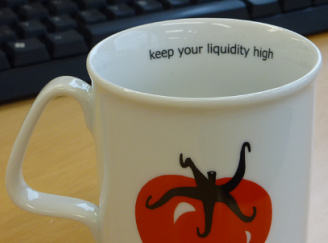
- Ab 5.11.2020: Certified Corporate Treasurer des VDT in Frankfurt. Der Kurs mit 5 Modulen beginnt am November 2020 und geht bis April 2021.
- Nov-2020: Kein Töggeli Turnier und kein Tomato-Apero bei Tomato Kloten
Alle diese Termine finden Sie unter https://www.tomato.ch/messen-seminare.html
More and more events are being held online, offering the opportunity to attend courses and events on other continents. We are listing a few choices that might interest you. Please let us know your interests so that we can include more of these types of events in our Tomato Catchup.
KPMG Digital Treasury Summit 2021 DTRS Wednesday 21. April 2021
https://home.kpmg/ch/en/home/events/2020/11/digital-treasury-summit-2020.html
Security Standard Council some Online Events:
From Florida Savannha Nov 01-04 2020:
Connecting People, Ideas, and Solutions Within the Higher Education Treasury and Finance Community
From Asia-Pacific: Nov 04-06 Help Secure Payment Data Sessions will be available in English, Japanese, and Chinese.
From India: Dec 09 Help Secure Payment Data
From Madrid Spain: Nov 04+05 European Banking Forum: Technology, Security and Risk 2020
From Washington DC: Nov 17 Virtual Cybersecurity & Fraud Summit
For decades, experts have been researching solutions for the transmission of viruses, especially influenza. With COVID-19, this has come to the forefront and promises effective solutions for spring 2021.
As the world is encountering the second COVID-19 wave and we know that the restrictions won’t go away anytime soon, I realize how much I miss eating in restaurants and visiting operas, rock concerts and exhibitions. That’s surprising because I usually don’t often go out for dinner and only once or twice a year to concerts.
Overall, I remain optimistic that we will conquer this crisis and life will return to normal. As optimistic as the Indian economist Amartya Sen (Nobel Prize Winner Economics 1998 and Deutscher Friedenspreis 2020).
In a recent NZZ interview in German he answered to: “You describe yourself as an "eternal optimist". Has this changed in the crisis year 2020?”
His answer: "The last few months could really make you wonder. But I remain an optimist. Throughout history, mankind has been confronted with major problems; and we have always recovered from them. This time will be no different, even though the pandemic is a problem of extraordinary magnitude. There is another good reason to be an optimist: optimism steers the mind in a productive direction. As an optimist, I ask myself how I can solve an existing problem instead of just complaining that it exists.”
Interview auf Deutsch in der NZZ Nobelpreisträger Amartya Sen über die Corona-Pandemie: «Die Geschichte zeigt, dass aus Katastrophen auch Gutes entstehen kann»
Let’s face the solutions you desired in your business; we will master them.
ENJOY