
Tomato Newsletter No. 233 - January 2021
Your monthly resource on working capital, process optimization, and issues related to the world of corporate treasurers, IT professionals, and bankers!
This newsletter is bilingual, English or German, depending on the source.
Introduction
Happy New Year to you and the Tomato Community!
After a peculiar year, 2021 already finds us more optimistic about the future. The vaccine that is administered as we speak has given us even more hope. Despite COVID, our personal life goes on. The beginning of the year usually finds us working on our list of resolutions. The past two years’ Forbes New Year Resolutions were very popular. Which ones of them did you choose?
In Forbes’ Resolutions for 2021, the author Tracy Brower suggests that even if usually over 80% of us struggle to keep our resolutions, there are 10 ways that can put us on a path toward a positive 2021. Check them under point 1.
We hope you’ll accomplish all your resolutions and find inspiration for your plans this year in this month’s newsletter. Moreover, remember that for any challenge related to financial aspects, you can reach out to Martin Schneider to discuss and clarify it. Contact Martin via email or call +41 44 814 2001.
This month’s Catch-Up includes topics such as transfer pricing, salaries in treasury, working and expats, corporate financial health, EU-UK Agreement post Brexit, artificial intelligence, and more.
- The Forbes 2021 New Year Resolutions are
- Tomato’s Expertise, Work and Projects in 2020
- Front-to-Back Office Report: How Are Functions in the Financial Industry Changing
- Transfer Pricing Implications of the COVID-19 Pandemic
- Salaries in Treasury
- German Cities in the “Expat City” Ranking 2020
- Corporate Financial Health - Interview with Prof. Edward Altman
- EU-UK Agreement; EU interests, fair competition, mututal interests
- ZEW-Studie in Mannheim: Deutschland und Schweiz verlieren an Attraktivität
- Book Tip - Competing in the Age of AI: Strategy and Leadership When Algorithms and Networks Run the World
- Termine & Events
- From the Desk of Tomato
1. The Forbes 2021 New Year Resolutions are
Martin suggests: Choose two or three from the list and stick to them. If you chose some for 2020, do you remember them? Did you have a way to keep track? I put my choices in outlook to refresh my memory each Monday. The resolutions on this year’s list:
- Make It Real
- Be Reasonable
- Tie Your Actions to Your Identity
- Link Your Habits
- Establish Accountability
- Share the Process (or The Pain)
- Realize the Power of Small Steps And Mark Progress
- Take Breaks
- Manage your Mindset
- Remember Your Why
Link to The Forbes Resolutions
2. Tomato’s Expertise, Work and Projects in 2020
With the exception of April and May, 2020 was a busy year for us, with new things, with the unexpected, with innovations that we dared together and mastered with success for our customers. Thank you for your trust !
Here are some areas where we provided solutions to our community in 2020:
- Continue on several projects: Payment and bank gateways;
- Evaluations of Payment Service Providers;
- Foreign Exchange Risk Reduction during Covid times in the southern hemisphere;
- TMS Software Implementation and Processes;
- Online Credit Card Payments with full automated data reconciliation in the ERP;
- In the US: replacing US check payments and enroll the ISO Format in Account Payables and BAI12 Format Receivables;
- Analysis of payment behavior in various countries;
- Treasury Policies and Corporate Risk Guidelines.
This year, we are keen to go the extra mile and expand this list according to our clients’ needs, interests and vision for 2021 and the years to come.
3. Front-to-Back Office Report: How Are Functions in the Financial Industry Changing
Cloud, artificial intelligence, and other digital technologies significantly improve business processes in the financial sector. However, a study by the banking Application Avaloq shows that client advisors, front-line employees, or regulation and risk management specialists will continue to be needed along the value chain. The study further uncovers:
- Employees have to do their part so that the potential of AI and analytics can be optimally exploited;
- Front office employees that can combine digital expertise with a strong understanding of customer needs are still indispensable;
- Over 50% of the bank customers surveyed would do banking and invest money through a provider outside the industry;
- Specific groups (women or start-ups) place greater emphasis on the ESG strategy of their financial institution;
- For 44% of respondents, ESG criteria are the most important factor in considering a change of financial service provider;
- The back and middle office functions will support the front office employees in providing better, more personalized, and more flexible customer service.
In Deutsch zusammengefasst von Finanz- und Wirtschaft: FUW: Der befähigte Mensch ist der Schlüssel zum Erfolg
Do you prefer English: Full report here
4. Transfer Pricing Implications of the COVID-19 Pandemic
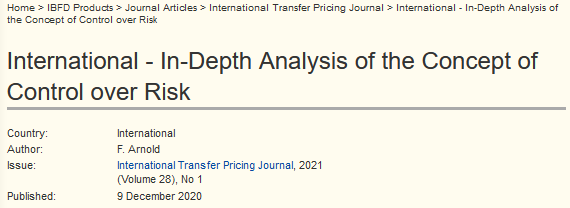
Fabian Arnold and I were working next door when Tomato was mandated to be part of the interim project in 2018. Fabian prepared the following study. Congrats Fabian, excellent work!
With the 2017 revision of the OECD Transfer Pricing Guidelines the OECD employs the “concept of control over risk” as the turning point in determining whether or not an associated party, which is contractually assuming risks, is from a transfer pricing perspective entitled to receive the higher returns associated with such risks. This IBFD* article by Fabian Arnold provides a historical context and critically evaluates this concept from a tax policy, general arm’s length as well as international corporate tax framework perspective.
Mit der 2017 erfolgten Überarbeitung der OECD-Verrechnungspreisrichtlinien verwendet die OECD das "concept of control over risk" als Wendepunkt bei der Bestimmung, ob eine verbundene Partei, die vertraglich Risiken übernimmt, aus einer Verrechnungspreisperspektive berechtigt ist, die mit diesen Risiken verbundenen höheren Renditen zu erhalten. Dieser IBFD*-Artikel von Fabian Arnold liefert einen historischen Kontext und bewertet dieses Konzept kritisch aus einer steuerpolitischen Perspektive, unter allgemeinen "arm's length"-Überlegungen sowie vor dem Hintergrund der Rahmenbedingungen des internationalen Unternehmenssteuerumfelds.
The Guidance focuses on four issues:
- Comparability analysis;
- Losses and the allocation of COVID-19 specific costs;
- Government assistance programs;
- Advance pricing agreements.
 Quelle: https://www.ibfd.org
 Quelle: https://www.ibfd.org
*IBFD is the world’s foremost authority on cross-border taxation. Tax practitioners from all over the world rely on its high-quality, independent tax research.
Mitarbeiter in den Finanzen werden jetzt dringender denn je gebraucht, um die Liquidität zu sichern und die finanziellen Risiken zu überblicken.
Wie beeinflusst Corona die Gehaltsaussichten und Jobperspektiven? Für den „FINANCE-Gehaltsreport 2020“ hat FINANCE die Vergütungszahlen von CFOs, Treasurern, Controllern und Co. zusammengetragen und eingeordnet.
Inhalt:
- Gehalt – So viel verdienen CFOs, Risikomanager, Wirtschaftsprüfer & Co.
- Digitalisierung – Welche Weiterbildungen sind jetzt wichtig?
- Interview – Hays-Experte Johannes Becker erklärt, welche Finanzexperten in der Coronakrise besonders gefragt sind
Do you prefer English?
Due to the corona pandemic, some companies implement austerity programs, short-time work, and restructuring, which has a great impact on salaries and job prospects. Fortunately, employees from the finance departments are now needed more than ever to secure liquidity and to keep track of the financial risks.
According to the Finance Salary Report 2020 by FINANCE and Hays, salaries of financiers will remain stable, and may even rise further.
- Top earners include CFOs, heads of M&A, and heads of finance;
- Controllers, treasurers, risk managers, and IR managers are in demand now.
Moreover, a Hays expert shares tips for successful salary negotiations: anyone who is showing themselves to be reliable and high-performing in the crisis can go into salary negotiations with the best cards after the pandemic.
In Deutsch vom Finance Magazin
The online reading of the interview is free; for download fill in your personal data.
Jahresgehalt der Führungsriege der Finanzabteilung in EUR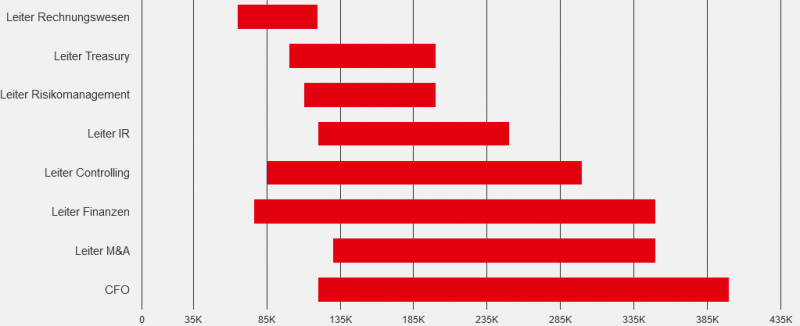 Quelle: www.finance-magazin.de
6. German Cities in “Expat City” Ranking 2020
InterNations, the largest expat community that carries out its Expat City Ranking, revealed the results of the 2020 ranking. While the Asian cities dominated the 2019 ranking, in 2020 new cities emerged on top.
- Top 10 best cities: Valencia, Alicante, Lisbon, Panama City, Singapore, Málaga, Buenos Aires, Kuala Lumpur, Madrid, and Abu Dhabi.
- Top 10 worst cities: Salmiya, Rome, Seoul, Milan, Nairobi, Paris, Johannesburg, Santiago, Dublin, and Hong Kong.
German cities in the ranking
- Düsseldorf (26th): high ranking in the work, economic situation, and career opportunities categories. Negative aspects: poor acclimatization and unfriendly residents.
- Frankfurt am Main (29th): working life is praised, but the lack of living space is still a problem. Moreover, the respondents agree that it is difficult to make friends, especially those without a (good) knowledge of German.
- Hamburg (33rd): offers the best working life in Germany. However, climate and weather are perceived as negative aspects. On the other hand, expats praise the quality of life, health, and the environment.
- Stuttgart (49th): the second hardest acclimatization. The city is listed the 63rd in the Finance & Living category, while in terms of friendliness, social contacts, and friendships, it comes on the 60th
Ziehen Sie Deutsch vor, dann lesen Sie den Bericht hier in XING
In English follow this link at internations.org
7. Corporate Financial Health - Interview with Prof. Edward Altman
Professor Edward I. Altman of the Stern School of Business, the creator of the Altman Z-Score, was interviewed by McKinsey on how executives can best face financial stress in times of crisis. Key highlights of the interview:
- Fundamental changes have emerged in the credit market: most companies are riskier today than they were in the 1960s (in the US, 100 companies were rated AAA, while today there are only 2). Moreover, an A rating is no longer the objective of companies.
- Due to government support around the globe, companies with low Z-Scores are surviving; in some countries, it is even impossible to go bankrupt, unless fraud is involved. However, the reduction in bankruptcies is temporary, and we will have a second wave once government supports are reduced.
- The Z-Score can be used as an early-warning system, an objective model that will show where a certain company stands in terms of a bond-rating equivalent or a zone of distress. Applied early enough, this approach can help executives take action (selling assets, cutting back on debt).
- To ensure resilience, companies need to maintain or improve performance on key drivers in the Z-Score: total assets and total liabilities. Companies could seek to concentrate assets while reducing investment in fixed assets if the situation is deteriorating. Moreover, companies are advised to stay away from borrowing, especially short-term.
Link to the Prof. Altmann report at McKinsey
8. EU-UK Agreement; EU Interests, Fair Competition, Mutual Interests
The European Commission has reached an agreement with the UK on the terms of its future cooperation with the EU. According to the official press release, it consists of three main pillars:
- A Free Trade Agreement
- Zero tariffs and zero quotas on all goods that comply with the appropriate rules of origin;
- Continued and sustainable air, road, rail, and maritime connectivity, though market access falls below what the Single Market offers;
- A new model for trading and interconnectivity, with guarantees for open and fair competition, including on safety standards for offshore, and production of renewable energy;
- UK's continued participation in EU programs for 2021-2027 (subject to a financial contribution by the UK to the EU budget), such as Horizon Europe.
- A new partnership for citizens' security
- A new framework for law enforcement and judicial cooperation in criminal and civil law matters.
- A horizontal agreement on Governance
- A Joint Partnership Council is established, which will ensure the Agreement is properly applied and interpreted, and all arising issues are discussed.
Here the link in English to ec-europa.eu you may switch to any European language
9. ZEW-Studie: Deutschland und Schweiz verlieren an Attraktivität
Der Bericht untersucht 21 Nationen. An der Spitze liegen die USA, Grossbritannien und die Niederlande. Allgemein haben sich diese Länder vorgearbeitet: die Niederlande, Polen, Tschechien und die USA. In Auftrag gegeben hat die Studie die Stiftung Familienunternehmen.
Der Wirtschaftsstandort Schweiz verliert weiter an Attraktivität und belegt Rang 6. Vor 10 Jahren hatte der Standort Schweiz noch den 2. Rang belegt.
Der Wirtschaftsstandort Deutschland rutschte vom 14. auf den 17. Platz.
Hier die Key Points zu Deutschland:
- Im Index seit 2006 um fünf Plätze zurückgefallen;
- Deutschland liegt im Mittelfeld bei allgemeinen Regulierungen;
- Im Steuersystem auf vorletzten Platz (Japan auf dem letzten Platz);
(USA, Frankreich und Belgien hätten ihre Wettbewerbsposition durch Steuersenkungen verbessert.) - Bei der Infrastruktur leicht überdurchschnittlich, muss aber den stärksten Verlust hinnehmen;
- Die Digitale Infrastruktur ist ausbaufähig;
- Als grosse Stärke des Standorts Deutschland gilt die finanzielle Stabilität von Staat und Privatwirtschaft sowie die damit verbundenen günstigen Finanzierungsbedingungen.
Key Point zur Schweiz:
- Trümpfe weist die Schweiz bei den Bedingungen für die Finanzierung und bei den Energiekosten auf;
- Schwachpunkte sind der Arbeitsmarkt und die Regulierungen.
Die Zusammenfassung für Deutschland lesen Sie bei SWR
Die Schweizer Zusammenfassung bei SwissInfo
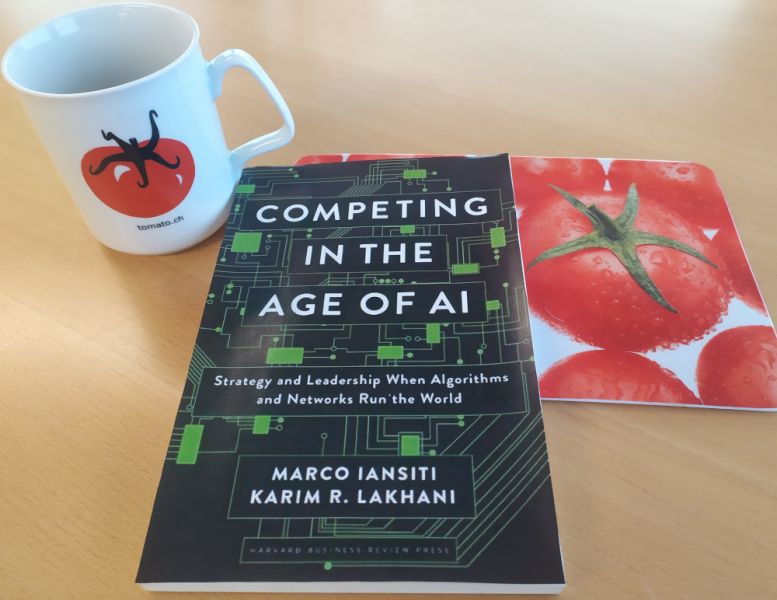
10. Book Tip - Competing in the Age of AI: Strategy and Leadership When Algorithms and Networks Run the World
Marco Iansiti and Karim R. Lakhani debate on how reinventing companies around data, analytics, and AI removes traditional constraints that have restricted business growth for hundreds of years. For companies, this book might be seen as an essential guide for learning how to compete and operate in the era of AI.
- The transformational effect of “the Age of A.I.” has been underappreciated so far;
- The algorithm-driven operating models of the AI economy are “almost infinitely scalable” ;
- While the Industrial Revolution relied on the benefits of vertical specialization, the AI era thrives on breaking down “anachronistic silos”. AI cuts horizontally across the organization, changing companies to the core by building data-centric operating architectures;
- With AI, “competitive advantage is shifting away from vertical capabilities toward universal capabilities in data sourcing, processing, analytics and algorithm development”;
- “The New Meta”, the “new reality that transcends the existing game rules or goes beyond traditional game limits and constraints.”, is governed by 5 rules:
- Change is no longer localized; it is systemic;
- Capabilities are increasingly horizontal and universal;
- Traditional industry boundaries are disappearing; recombination is now the rule;
- From constrained operations to frictionless impact;
- Concentration and inequality will likely get worse.
- UK FinTech Mission to Austria & Switzerland 2021; 28 January
https://uk-fintech-mission-2021.b2match.io/ - Profit Allocation Within Multinational Enterprises in the New Decade; 21-22 January
Details as PDF - Open Banking MENA – Harnessing API Technology and Open Banking to Transform the Future of Banking and Payments; 25 January
https://openbanking.gmevents.ae/ - Artificial Intelligence in Financial Services 2021; virtual event; 3-4 February
https://www.arena-international.com/aifs/
Kennen Sie den Begriff Blue Zones? Das Geheimnis eines langen Lebens?
Die Blue Zones faszinieren nicht nur Wissenschaftler, denn nirgends sonst werden die Menschen so alt und bleiben so lange gesund. Was können wir von den Blue Zones lernen?
Im Jahr 2005 publizierte das Magazin "National Geographic" den Artikel "The Secrets of Long Life" von Dan Buettner. Zusammen mit den Wissenschaftlern Gianni Pes und Michel Poulain reisten sie jahrelang um die Welt, um Gebiete zu finden, in denen die Menschen am längsten leben und am längsten gesund bleiben. Er identifizierte fünf Regionen als „Blue Zones“:
- Ikaria in Griechenland
Ernährung: Mittelmeerdiät mit viel Gemüse, Olivenöl und Fisch - Okinawa in Japan
Süsskartoffeln, Soja und viele Gemüsesorten anbauen.
Zur Blue Zone wurde Okinawa vor allem, weil dort die ältesten Frauen leben - Ogliastra auf Sardinien
Ernährung: Kartoffeln, Bohnen, Getreide und Gemüse, außerdem Milchprodukte von den Weidetieren, die viele Omega-3-Fettsäuren.
Auf Sardinien leben die meisten über 100-jährige Männer. - Loma Linda in Kalifornien
In der Kleinstadt Loma Linda in Kalifornien leben besonders viele Siebenten-Tags-Adventisten
Essen: Pflanzliche Ernährung
Einige Wissenschaftler haben nachgewiesen, dass Menschen, die einen starken Glauben haben und regelmäßig in die Kirche gehen, im Schnitt etwas älter werden und länger gesund bleiben als der Durchschnitt. - Die Halbinsel Nicoya in Costa Rica
Laut National Geographic ist die Sterblichkeitsrate im mittleren Alter am niedrigsten
Link in Deutsch bei Utopia.de
Do you prefer English: https://www.bluezones.com/
Die NZZ publizierte am Wochenende die Blue Zone zur Insel Ikaria in Griechenland
Wenn man gesund altern darf sind doch schon mal positive Aussichten auf Leben !
Enjoy Martin and the Tomato Team

Foto: CC0 / Pixabay / PICNIC_Fotografie