
TOMATO CATCH-UP - Newsletter Issue 290 - October 2026
Your monthly resource on working capital, process optimization, and issues related to the world of corporate treasurers, IT professionals, and bankers!
This newsletter is bilingual, English or German, depending on the source.
Introduction
Since 2012, the Reuters Institute Digital News Survey annually examines general trends and national differences in news consumption. Meanwhile, the research has grown to 48 countries. Findings in summer 2026 for Germany are: (The Hamburg Leibnitz institute is responsible for the German review
- Television, radio, and print remain important news sources.
- Young people 17-24 years consume news via social media.
- Concerns about misinformation are increasing throughout all groups.
- In Germany, trust in news remains stable.
Details in English and German at Leibnitz Institute.
This edition includes topics such as Structured Finance 2026, French Debt Stress, Earnings in Treasury, AI in Finance, Nobel Prize in Economics, Swiss Workforce, Strong Connections, and more.
Remember that for any challenge related to your financial issues, you can ask Martin Schneider for a discussion that will clarify it. Contact Martin via email or call +41 44 814 2001.
- Structured Finance Stuttgart Nov 25 & 26
- French Debt Stress and the Corporate Borrowing
- Gehälter für Interim CFOs und Treasurer 202
- KPMG AI in Finance Report 2026 – Key Findings
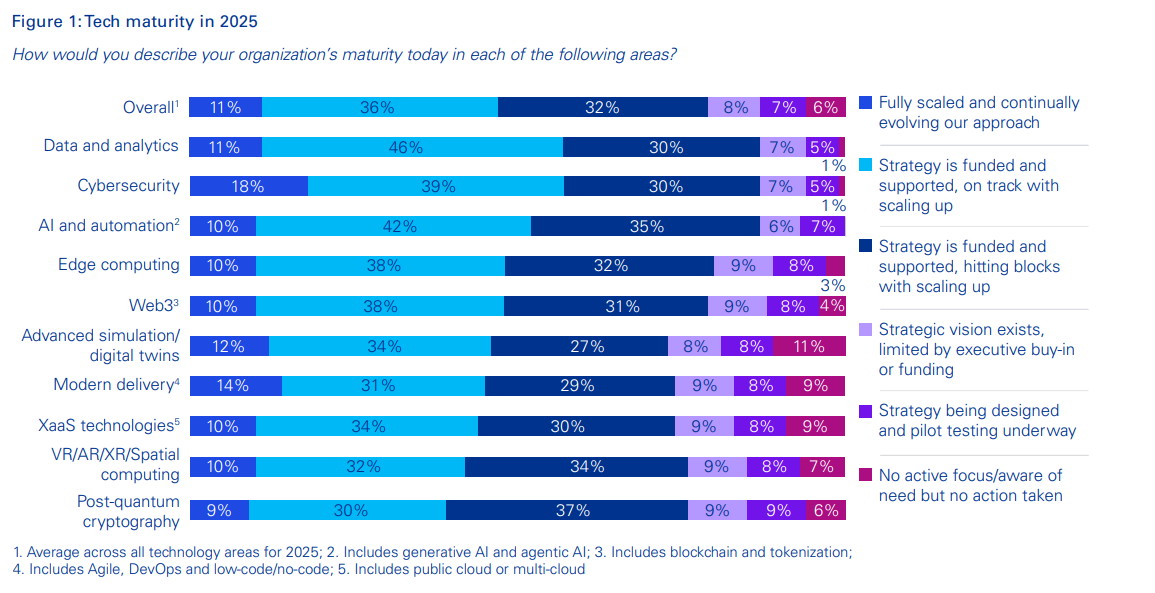
- KPMG Global Tech Report Findings
- Nobel Prize in Economics Winners 2026
- Global Workforce Survey: Findings for Switzerland
- Book Tip – Vibe: The Secrets of Strong Connections in a Lonely World
- Termine & Events
- From the Desk of Tomato «Das ideale Treasury»
1. Structured Finance Stuttgart Nov 25 & 26
Ist die Messe Structured Finance im November 2026 wieder in Ihren Plänen? Ich würde mich freuen Sie in Stuttgart wiederzusehen! Kontaktieren Sie Martin Schneider für einen Termin in Stuttgart.
Gern können wir bereits vorab per Mail, LinkedIn oder Telefon einen Termin vereinbaren. So lässt sich der Tag gemeinsam planen – zwischen den Workshops oder frühmorgens bei einem sehr guten Kaffee am bekannten Unicredit Stand. 😊
So treffen wir uns: Suchen Sie Martin Schneider im Messeraum? Via der SF 2026 App oder eine Koordination mit unserem Kollegen Esra Kummer im Tomato Atelier Zürich-Kloten +41 44 814 2001.
2. French Debt Stress and the Corporate Borrowing
An article by Tomato’s Interim Hervé Schall. France’s debt turmoil can spread to industrial borrowers through shared banks and bond investors. Banks may raise loan margins or lend less, while bond investors may demand higher returns.
Refinancing borrowers are most exposed; a broad rise in industrial loan margins is not yet established. Important articles to the theme:
- Widening spreads for private borrowers. Interview Les Echos with Patrick Montagner, Member of the Supervisory Board of the ECB. Les Echos is the leading and oldest French financial newspaper. Read interview en Français and in English.
- Spillovers to European corporate debt: an article by FT (Financial Times) (subscription needed)
- Pressure on European banks as sovereign yields rise are reported at Investing.com
The 2010 to 2012 euro-area crisis showed how sovereign debt stress could restrict bank lending to businesses.
Greece’s 2015 crisis showed how capital controls could disrupt payments and import finance.
Tomato’s experienced interim Treasurer Hervé Schall can help by securing credit lines early, diversifying lenders and maturities, testing cash and covenant headroom, and managing interest-rate and currency risks.
Picture below: France’s 10-year borrowing premium over Germany
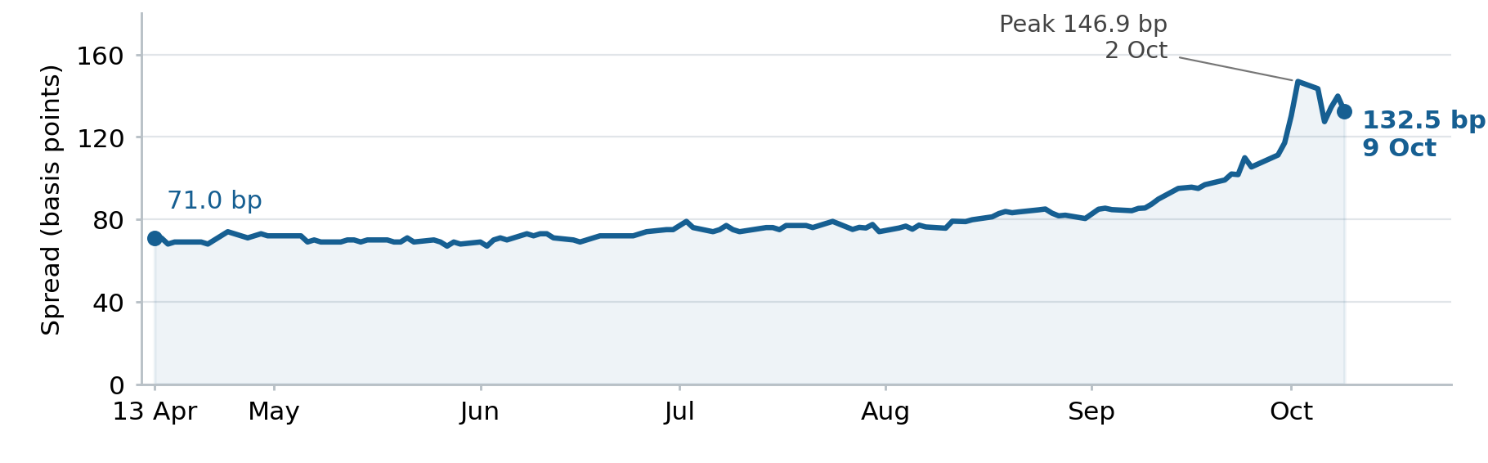
Daily observations, 13 Apr–9 Oct 2026. French 10-year OAT yield minus German Bund yield, in basis points.
Source: Ideal Investisseur citing Banque de France and Deutsche Bundesbank.
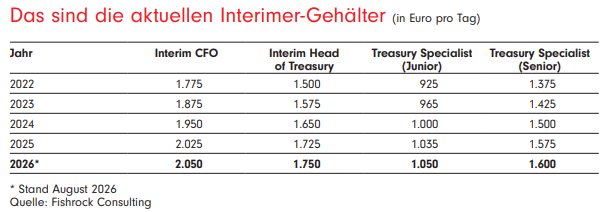
3. Gehälter für Interim CFOs und Treasurer 2026
Ein Bericht von DerTreasurer im Interview mit Fishrock (operativer Schwerpunkt für Norddeutschen Mittelstand). Das Anforderungsprofil für Interim-Manager passt sich den Anforderungen an. Interim-Arbeits-Kräfte für traditionelle operative Aufgaben sind gefragt mit Konzentration auf Themenbereiche wie Liquiditäts- und Cash-Optimierung, Treasury-Systeme, Digitalisierung (TMS-Implementierungen, ERP-Integration) sowie Risikomanagement (Devisen, Zinsen, Refinanzierung).
Systemimplementierungen und Upgrades von Treasury-Management-Systemen spielen eine immer bedeutendere Rolle, oft mit längeren Projektlaufzeiten von sechs bis 18 Monaten.
Interim-Manager sind vom ersten Arbeitstag enorm gefordert und sollen zeitnah messbare Ergebnisse liefern. Aufgaben im Change-Management und im Linienmanagement können dazugehören.
Do you prefer English?
Fishrock in Hamburg compares Treasury Interim salaries at DerTreasurer. Do you wish to compare Treasury Salaries throughout Europe? Check out BrewerMorris
Keywords für Ihre bevorzugte KI sind: Interim-Manager, Liquiditäts- und Cash-Optimierung, TMS-Implementierungen, ERP-Integration
4. KPMG AI in Finance Report 2026 – Key Findings
The KPMG Global AI in Finance Report surveyed 1013 leaders in 20 countries and 13 sectors. Here are the main findings:
- In the 75% of the surveyed organizations, active AI use across finance has more than doubled since 2024.
- 76% are actively leveraging AI in financial planning.
- 70% report improved decision-making quality over the past year.
- 76% report moderate or significant improvement from agentic deployers.
- 60% of agentic AI leaders are strongly assurance-ready.
- 38% invest in training their existing finance teams on AI processes.
- 28% rethink the types of talent their finance functions need.
- AI is producing the largest gains in judgement-heavy work: planning, forecasting, and risk assessment.
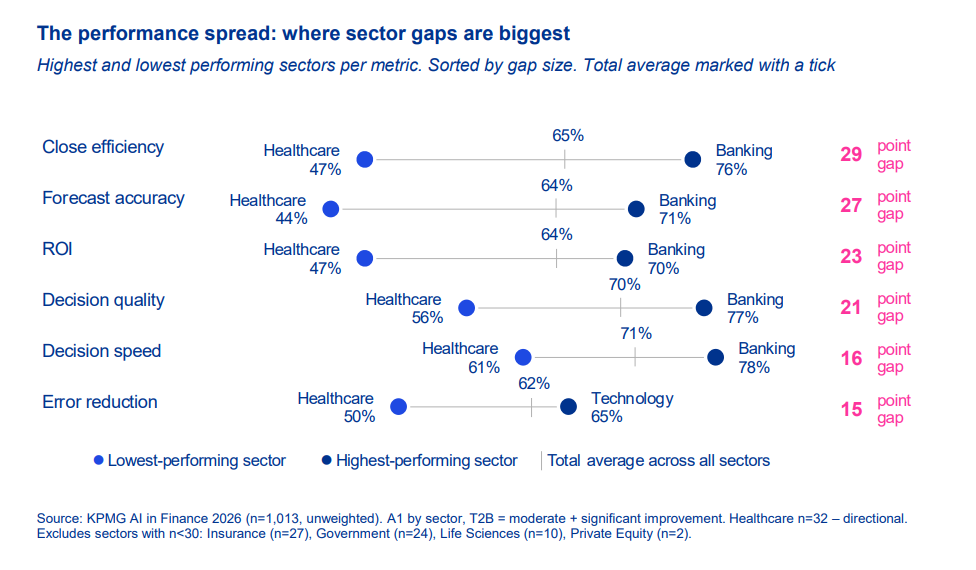
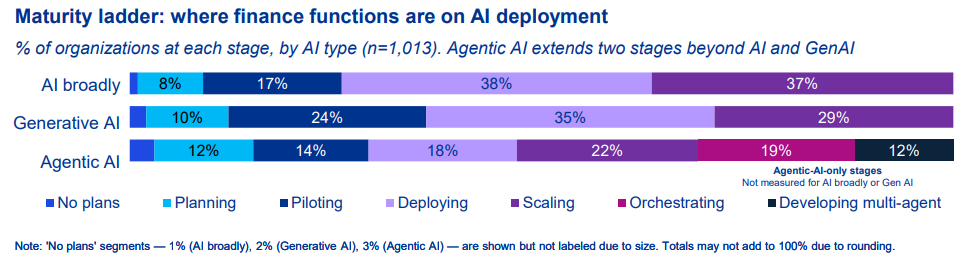
Further details at KPMG or enter keywords into your AI tool to find out more
Keywords for your preferred AI: agentic deployers, agentic AI, AI processes, finance functions
5. KPMG Global Tech Report Findings
The KPMG Global Tech Report surveyed 2500 tech executives in 27 countries (43% EMEA, 29% APAC, 28% Americas). Here are the main takeaways from the organizations that outperform (5% of the tech executives surveyed; they stand out for their advanced implementation across core technologies, mature operational practices and high returns on their digital tech investments):
- 50% of permanent human staff are expected to remain in place by 2027, despite the adoption of agentic AI – continued value of human expertise alongside AI-driven capabilities.
- 57% of companies plan to increase the onshore technology talent over the next year.
- 49% plan to enhance data sovereignty audits across their partnership ecosystems.
- They are 21% more likely to increase scrutiny of the geographic location of their cybersecurity partners over the next year.
- 85% collaborate frequently with external partners in tech ecosystems.
- 87% are more likely to agree that they should take more risks on emerging technologies to stay relevant in their industry.
Keywords for your preferred AI: agentic AI, digital tech investments, data sovereignty audits, onshore technology, emerging technologies, cybersecurity partners
6. Nobel Prize in Economics Winners 2026
Stanford University’s Robert E. Hall and Columbia University’s Michael Woodford won the Nobel Prize for Economics for demonstrating how central banks and finance ministries can more effectively mitigate the effects of crises.
Through their research, the two professors laid the foundation for New Keynesian macroeconomics, a macroeconomic theory of the 1980s-early 2000s. They found macroeconomics is important, but households and businesses are the ones actually making financial decisions based on what’s happening now and what they think is going to happen next. Hall focused on how households make purchasing decisions (demand), while Woodward looked at how businesses set prices (supply).

Ill. Niklas Elmehed © Nobel Prize Outreach
Keywords for your preferred AI: Nobel Prize 2026 Economics Winners
7. Global Workforce Survey: Findings for Switzerland
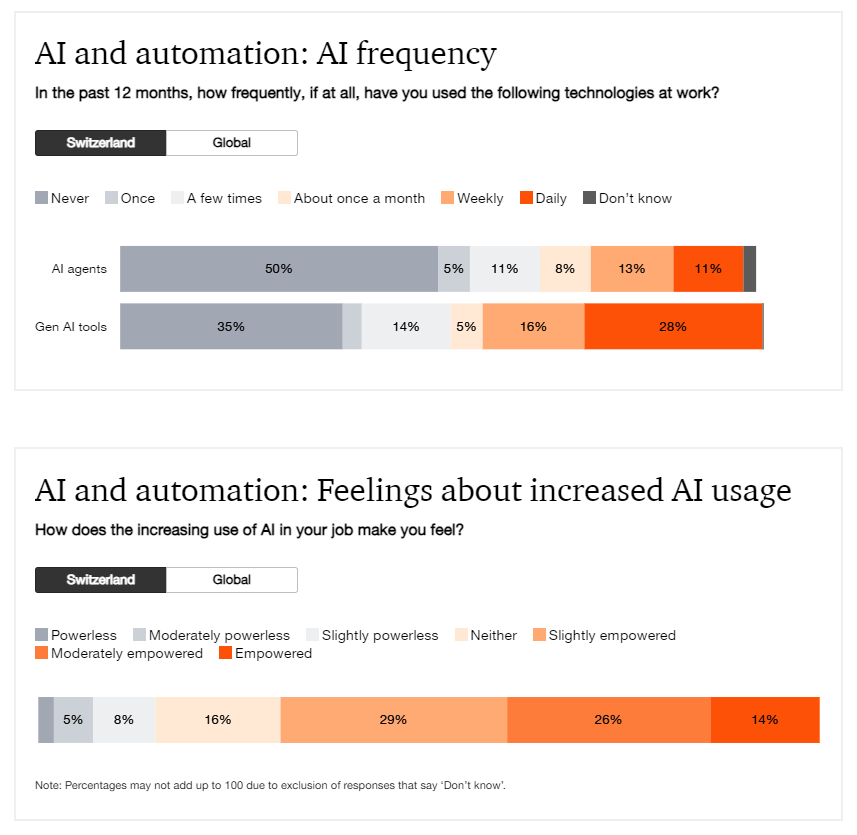
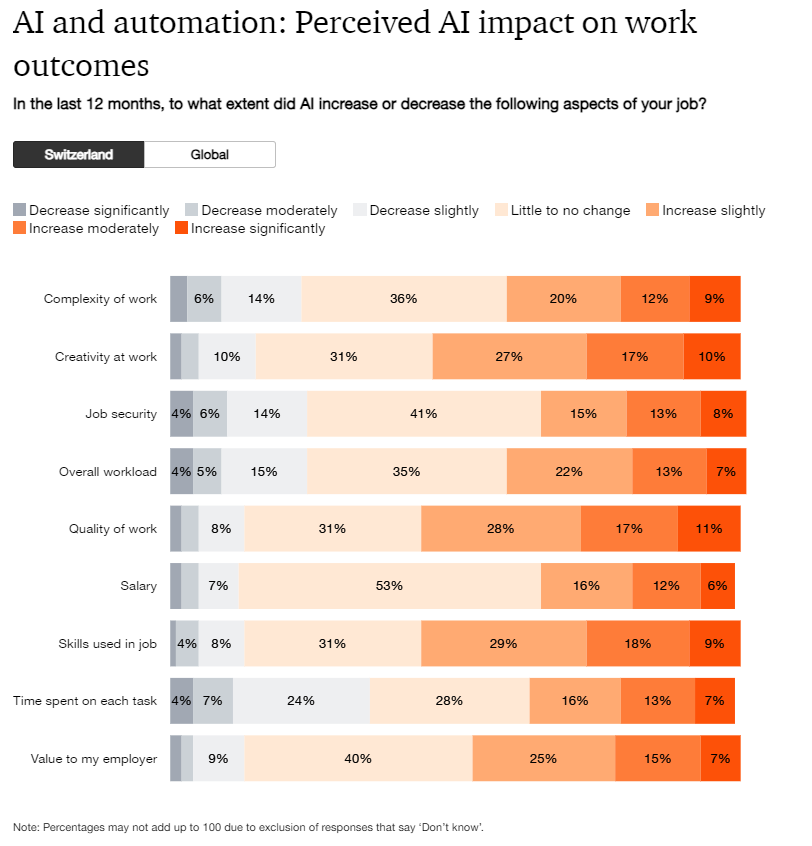
PwC reports findings on their latest Global Workforce Hopes and Fears Survey 2026. Swiss workers are among the most active users of AI and they bring strong skills to their roles. The survey captured the views of 49,364 workers across 48 countries and regions and 29 sectors in May and June 2026.
Takeaways:
- 69% Swiss workers sit in the Core Workforce with low AI advantage and low talent-market advantage compared with 56% globally.
- 8% are Frontrunners (14% globally).
- Daily generative AI use is higher in Switzerland (28% vs 22% globally), yet only 14% of Swiss workers feel energised or empowered by AI (vs 19% globally).
- Swiss workers feel secure in their roles and less exposed to global disruption.
Details at PwC Workforce Hope and Fears
Or enter keywords into your AI to find out more: generative AI
8. Book Tip – Vibe: The Secrets of Strong Connections in a Lonely World
Developing deep connections is one of the most pressing issues of our times. Our loneliness shows no signs of slowing as social media forces in-person interactions behind digital screens, communication is outsourced to AI, and the world grows more polarized.
Adam Grant shows how we can create connections that are quicker, more robust, and last longer. The book unveils that closeness doesn't always require time, chemistry doesn't always come immediately, and solidarity doesn't always require likeness.
Regardless of your level of interpersonal skills, this book will help you communicate with others more effectively.

9. Termine & Events
- Oct 15, 2026: 6th International Hellenic Association of Treasurers (HAT) Treasury Summit, Athens, Greece
- Oct 16, 2026: Tokenised Liquidity: Rethinking MMFs (Online Webinar, 9:00AM-9:45AM)
- Oct. 22, 2026: London Treasury Network: What's Brewing in AI? (location to be confirmed upon booking), London, UK
- Nov 3, 2026: ePay Europe Summit eCommerce Payments 2026, London, UK
- Nov 4, 2026: Instant Payments Summit, Toronto, Canda
- Nov. 4, 2026: London Treasury Network: Tax and Treasury even, London, UK
- Nov 8-11, 2026: AFP 2026 Conference, Las Vegas, USA
- Nov 11, 2026: ACT Annual Dinner, London, UK
- Nov 18, 2026: Treasury Indonesia 2026: Navigating Treasury Priorities in a Changing Economy, Jakarta, Indonesia
- Nov 24, 2026: TreasuryTech 2026, London, UK
- Nov 25-26, 2026: Structured Finance, Stuttgart, in Deutsch
- Nov 26-27, 2026: AFTE (Association Française des Trésoriers d'Entreprise) Days 2026, Paris, France
- March 10, 2027: Deals of the Year Awards 2026 by ACT, London, UK
10. From the Desk of Tomato «Das ideale Treasury»
Mit diesem Desk of Tomato starte ich eine Serie von unabhängigen Meinungen, wie ich selber ein Treasury nach 30 Jahren Berufserfahrung aufstellen würde:
- Das Corporate Headquarter gibt die finanziellen Konzernziele unmissverständlich und nahezu ausnahmslos vor. Ein klarer Zentralismus steuert die Organisation; föderale Alleingänge werden nur mit explizitem Einverständnis des Headquarters geduldet. Autonome Sonderwege („gallische Dörfer“) sind auf ein Minimum zu reduzieren.
- CFO und Treasurer agieren als enges, vertrauensvolles Team (analog zum bekannten Film „Ziemlich beste Freunde“). Sologänge, Egoismen oder das Aussitzen von Problemen haben langfristig katastrophale Auswirkungen auf die gesamten Finanzen und deren Berichtswesen.
- Der CFO agiert als Enabler für das Group Treasury, indem er gezielt Ressourcen für Weiterbildung, moderne IT-Infrastruktur und optimierte Prozesse freisetzt.
Fühlen Sie sich wiedergefunden in Ihren CFO- und Treasury-Tätigkeiten?
Stay tuned and more to come in the next Desk of…. Viel Freude wünscht Ihnen das Tomato Team.